
What Is Peripheral Neuropathy? The Complete Guide (2026)

I remember sitting in my doctor’s office, staring at a pamphlet that said “peripheral neuropathy” at the top.
She had just told me that the burning in my feet — the thing I had been dismissing as “bad circulation” for two years — had a name. And that name meant nerve damage.
I drove home in a daze. That night, I started researching. And I have not stopped since.
If you are reading this, you are probably in a similar place. Maybe you just got a diagnosis. Maybe you have been dealing with numb, tingling feet for months and finally Googled it.
Either way — you are in the right place. I am going to explain exactly what is happening in your body, why it happens, and what the research actually says you can do about it.
I am not a doctor. I am a 54-year-old former science teacher who got a diagnosis that changed my life — and spent two years reading every study I could find.
The Bottom Line
- Peripheral neuropathy is nerve damage affecting 20-30 million Americans — most often caused by diabetes (NIH/NINDS, 2025)
- It causes burning, tingling, and numbness — usually starting in the feet and hands
- Prevalence rises sharply with age: 26.8% of adults 65+ are affected (Scientific Reports/PMC, 2021)
- Research supports alpha lipoic acid, B12, and lifestyle changes for meaningful symptom relief (PMC Review, 2024)
What Exactly Is Peripheral Neuropathy?
Peripheral neuropathy affects an estimated 20-30 million Americans, yet many live with symptoms for years without a diagnosis (NIH/NINDS, 2025). It is damage to your peripheral nervous system — the vast network of nerves that connects your brain and spinal cord to the rest of your body, including your feet, hands, and organs.
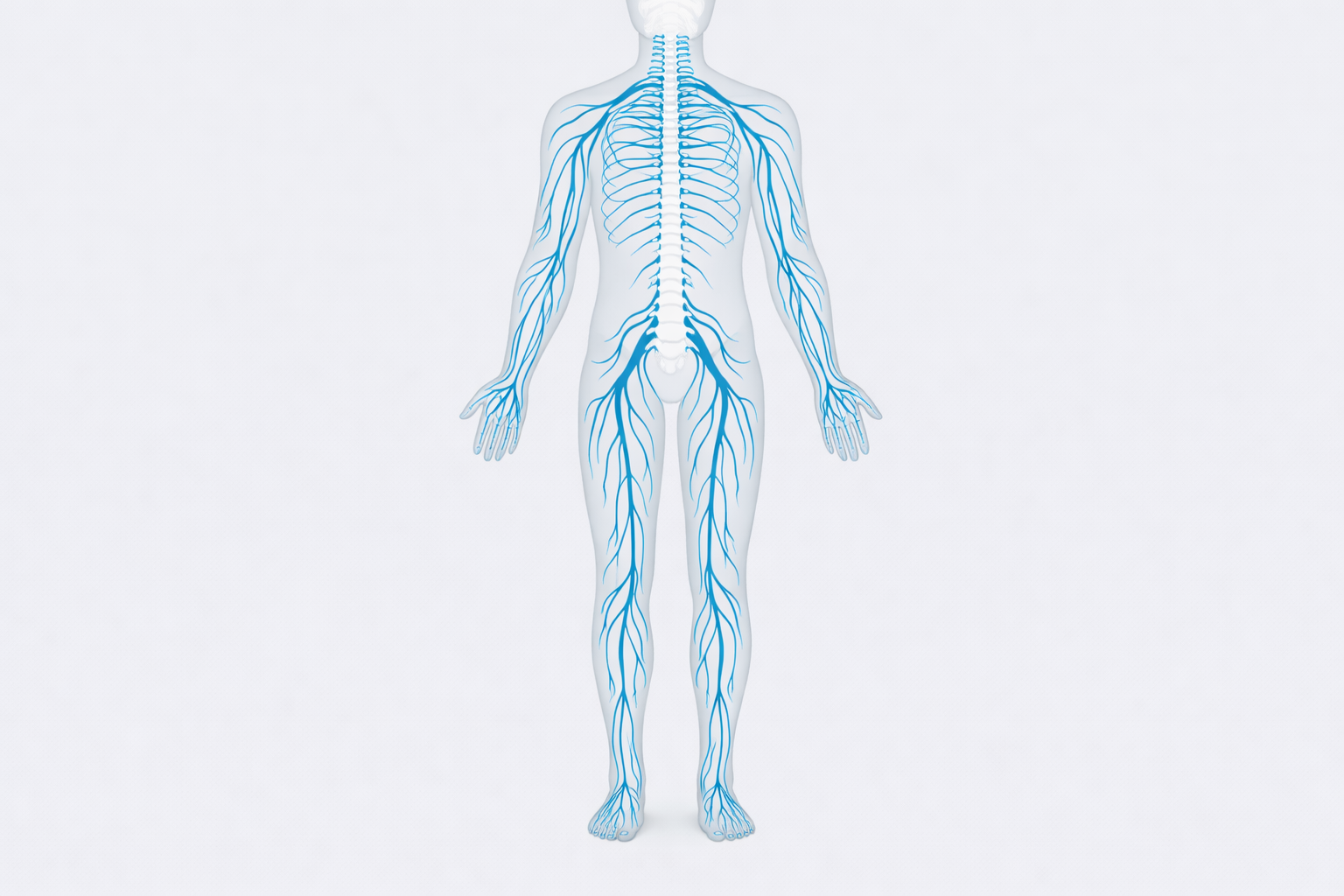
Think of your nervous system like the electrical wiring in a house. Your brain is the fuse box. Your spinal cord is the main line. And peripheral nerves are the individual wires that run to every room. Peripheral neuropathy is like having faulty wiring in specific rooms. The signals still try to get through — but they arrive distorted, delayed, or not at all.
My experience: When my neurologist first explained this to me, I was confused. I had always assumed nerve damage meant paralysis or something dramatic. What I did not know was that nerve damage can feel like burning, or static, or nothing at all. The absence of feeling can be just as serious as pain.
Why does neuropathy usually start in the feet? Because the nerves reaching your toes are the longest in your body — over three feet long in most adults. Longer nerves are more vulnerable to damage and are often first to show symptoms.
What Does Peripheral Neuropathy Feel Like?
The most common symptoms are tingling, burning, and numbness — usually starting in the feet and hands and spreading upward over time (Mayo Clinic, 2024). Symptoms often appear gradually and can vary widely from person to person.
- Burning or tingling — described as “walking on hot coals” or “pins and needles that will not stop”
- Numbness — partial or complete loss of sensation in feet or hands
- Sharp, stabbing pain — sudden jolts that can be severe
- Extreme sensitivity to touch — even a bedsheet can feel painful (called allodynia)
- Muscle weakness — trouble gripping objects or lifting the front of your foot
- Balance problems — falling more easily, unsteady gait
- Feeling like you are wearing socks — when you are not
- Symptoms worse at night — a telltale sign reported by most patients
For me, it was the burning feet at 2 a.m. that finally pushed me to call my doctor. I had been awake three nights in a row. Not a dull ache — actual burning. I kept checking if something was touching my feet. Nothing was. That is often how it starts.
According to a 2025 study, among adults with a median age of 84, 62.4% showed signs of peripheral neuropathy — most of them undiagnosed (PubMed, 2025). The condition is far more common than most people realize.
The 3 Types of Peripheral Neuropathy — and Why It Matters
More than 100 types of peripheral neuropathy have been identified (NINDS, 2024). But most cases fall into three categories based on which nerves are affected. Knowing your type helps predict symptoms — and guides treatment.
| Type | Nerves Affected | Most Common Symptoms |
|---|---|---|
| Sensory | Sensation/feeling | Burning, tingling, numbness, pain |
| Motor | Movement/muscles | Weakness, coordination problems, foot drop |
| Autonomic | Automatic functions | Blood pressure, digestion, sweating issues |
Sensory neuropathy is the most common — and the one most people mean when they say “neuropathy.” These nerves handle temperature, pain, touch, and vibration. Motor neuropathy affects the nerves controlling movement. You might notice weakness when climbing stairs or your foot “slapping” when you walk (foot drop). Autonomic neuropathy affects automatic functions: heart rate, blood pressure, digestion, bladder.
What most articles miss: Many people with sensory neuropathy also have some degree of motor involvement — they just do not notice it until symptoms progress. If you have burning feet, ask your doctor specifically about motor nerve function too.
What Causes Peripheral Neuropathy?
Diabetes is the leading cause, responsible for an estimated 13.2 million cases of diabetic peripheral neuropathy in the United States (PMC, 2019). Chronically high blood sugar damages nerve fibers over time — starting with the longest nerves first. But diabetes is not the only cause:
- Diabetes and prediabetes — High blood sugar is toxic to nerve cells. Even prediabetes can cause early nerve damage.
- Vitamin B12 deficiency — One of the most treatable causes. B12 is essential for myelin, the protective coating around nerves.
- Alcohol use — Alcohol is directly toxic to nerve tissue.
- Chemotherapy — Many cancer drugs cause chemo-induced peripheral neuropathy (CIPN).
- Autoimmune conditions — Lupus, rheumatoid arthritis, and Guillain-Barré syndrome can trigger nerve attacks.
- Thyroid disease — Both hypothyroidism and hyperthyroidism can cause nerve damage.
- Infections — Lyme disease, shingles, and HIV can damage peripheral nerves.
- Idiopathic (unknown cause) — 25-30% of cases have no identifiable cause (NINDS, 2024).
My neuropathy came from years of poorly controlled blood sugar. I did not know I was prediabetic until my Type 2 diagnosis at 48. By then, the nerve damage was already underway. Knowing the cause did not undo the damage — but it told me exactly what to address.
How Is Peripheral Neuropathy Diagnosed?
Peripheral neuropathy is often underdiagnosed — an estimated 20-30 million Americans have it, but many are never told (Foundation for Peripheral Neuropathy, 2024). Doctors diagnose it through physical examination, blood tests, and nerve studies.
Physical exam: Your doctor will check reflexes, test your response to touch and temperature, and evaluate balance. Blood tests: Look for blood sugar levels, B12, thyroid function, and inflammatory markers. Nerve Conduction Study (NCS/EMG): Measures how fast electrical signals travel through your nerves. It sounds scary — it is more strange than painful. Skin biopsy: Used when small fiber neuropathy is suspected.
My diagnosis took three appointments and a nerve conduction test. The NCS felt like mild static electricity. But the results were clear: significant nerve damage in both feet, consistent with diabetic peripheral neuropathy. If you suspect neuropathy, do not wait. Earlier diagnosis means more treatment options.
Can Peripheral Neuropathy Be Reversed?
In some cases, yes — especially if caught early and the underlying cause is treated (Mayo Clinic, 2024). The key question is: what is causing it?
Where reversal is possible: B12 deficiency neuropathy (supplementing with methylcobalamin can significantly improve symptoms), alcohol-induced neuropathy (with abstinence, nerves can heal), compressive neuropathy (releasing pressure allows recovery), and thyroid-related neuropathy (treating thyroid often improves nerve symptoms).
Where management is the goal: Diabetic neuropathy rarely reverses fully, but with tight blood sugar control, progression can be slowed or stopped. A 2024 PMC review found that alpha lipoic acid (ALA) shows both safety and efficacy for neuropathic pain — with clinical improvements in pain, tingling, and nerve function (PMC, 2024).
Natural Approaches That Research Supports
While no supplement cures neuropathy, research supports several natural strategies that can meaningfully reduce symptoms (Medical News Today, 2024). These are not miracle cures — they are tools that, used consistently, can make a real difference in daily life.
- Diet: Anti-inflammatory eating patterns (Mediterranean diet, low-glycemic foods) help manage blood sugar and reduce nerve inflammation.
- Exercise: Regular movement — even gentle walking — improves blood flow to peripheral nerves and can reduce pain intensity.
- Alpha Lipoic Acid (ALA): The most researched supplement for neuropathy. Acts as a powerful antioxidant that reduces oxidative stress in nerve tissue. Both oral (300-600mg/day) and IV forms show clinical benefit.
- Vitamin B12 (methylcobalamin): Essential for myelin repair. The methylcobalamin form is better absorbed and more active in nerve tissue than the cheaper cyanocobalamin form.
- Magnesium: Plays a role in nerve signal transmission. Deficiency is linked to increased neuropathic pain.
- TENS therapy: Transcutaneous electrical nerve stimulation devices can provide temporary pain relief. Available without a prescription.
Mark’s Take: After two years of research and personal experimentation, the two things that made the biggest difference for me were tightening my blood sugar control and adding methylcobalamin B12. If I were starting over, those would be my first two steps — not because they are magic, but because the evidence actually supports them.
When to See a Doctor — Red Flags to Take Seriously
Peripheral neuropathy is rarely an emergency — but some symptoms demand immediate medical attention (Mayo Clinic, 2024).
See a doctor immediately if you experience: Sudden onset of severe numbness or weakness (especially one-sided), rapidly spreading symptoms over hours or days, foot wounds or ulcers that will not heal (critical for diabetics), or loss of bladder or bowel control.
See a doctor within 1-2 weeks if: You have burning, tingling, or numbness in feet or hands that has persisted for more than a few weeks, symptoms are interfering with sleep or daily function, or you have diabetes and any new foot symptoms.
Frequently Asked Questions
What is the most common cause of peripheral neuropathy?
Diabetes is the leading cause, responsible for approximately 13.2 million cases of diabetic peripheral neuropathy in the United States alone (PMC, 2019). Chronically high blood sugar damages nerve fibers over time — especially the longest nerves, which reach the feet first.
What does peripheral neuropathy feel like?
Most people describe burning, tingling, or “pins and needles” sensations — usually in the feet first, progressing upward. Some experience sharp, stabbing pain or extreme sensitivity to touch. Many report symptoms are worse at night. A common description: “It feels like I am always wearing invisible socks.”
Can peripheral neuropathy go away on its own?
It depends on the cause. Neuropathy from B12 deficiency or alcohol use can improve significantly with treatment. Diabetic neuropathy rarely reverses fully but can be slowed with tight blood sugar control. Idiopathic neuropathy typically requires symptom management rather than resolution.
Is peripheral neuropathy serious?
Yes — it deserves serious attention. Beyond pain, untreated neuropathy can cause falls, foot ulcers, and infections — especially dangerous for diabetics. Numbness means you can injure your feet without feeling it. Early management significantly reduces complication risk.
What vitamins help with peripheral neuropathy?
Research most strongly supports B12 (methylcobalamin form), alpha lipoic acid (ALA), and benfotiamine (a fat-soluble form of B1). These have the most clinical evidence for nerve function support and pain reduction (Medical News Today, Mayo Clinic, 2024).
How many people have peripheral neuropathy in the US?
Estimates range from 20 to 30 million Americans, but true numbers are likely higher due to widespread underdiagnosis. Prevalence rises sharply with age — affecting approximately 26.8% of adults 65+ and up to 62% of those in their 80s (NIH, PubMed, 2025).

You Are Not Alone — and This Is Not the End of Your Story
Peripheral neuropathy is a real condition. The burning, the tingling, the sleepless nights — those are real. You are not imagining it, and you are not weak for struggling with it.
But here is what I know after two years of research: there is more you can do than most doctors tell you in a 15-minute appointment. The path forward starts with understanding. You have taken that step today.
Until next time,
Mark Whitfield
NeuropathyHealthGuide.com
Medical Disclaimer: The information on this page is for educational and informational purposes only. It is not intended as medical advice and should not replace consultation with a qualified healthcare provider. Peripheral neuropathy is a serious medical condition — please speak with your doctor before making any changes to your treatment plan, diet, or supplement regimen. Individual results vary. Mark Whitfield is not a licensed medical professional. His content reflects personal research and experience, not clinical practice.